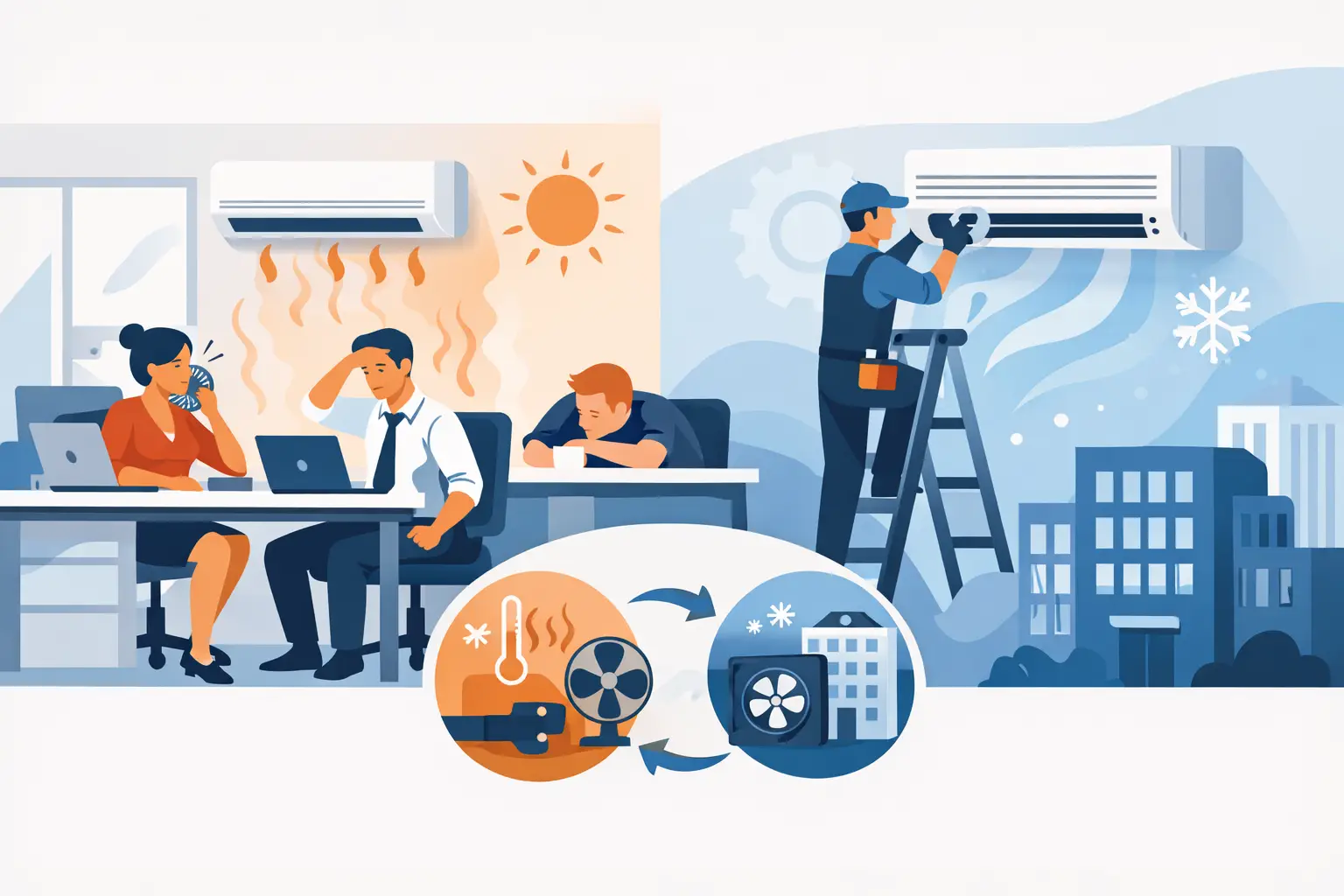
By 10:30 a.m., the conference room is stuffy, employees are opening doors to get air moving, and the thermostat still reads 78. In Houston, an office cooling failure recovery example is not just a maintenance story - it is a business continuity issue. When a commercial AC system goes down, the right response can limit downtime, protect equipment, and get people back to work without turning a bad day into a full operational mess.
For small and mid-sized offices, cooling failures usually feel sudden, but the recovery process should not be improvised. The fastest path back to normal starts with a clear sequence: confirm the scope of the issue, stabilize the space, diagnose the system accurately, make the right repair, and address the conditions that caused the breakdown in the first place. That is where a technician-led response matters.
An office cooling failure recovery example in real terms
Picture a two-story professional office in northwest Houston during a July heatwave. Around 9 a.m., staff begin reporting warm air from the vents on the second floor. The first floor is still tolerable, but by late morning the upstairs thermostat climbs past 80, computers are running hot, and productivity starts slipping. The property manager checks the thermostat settings, replaces the batteries, and confirms the breaker has not tripped. The problem is clearly bigger than a simple control issue.
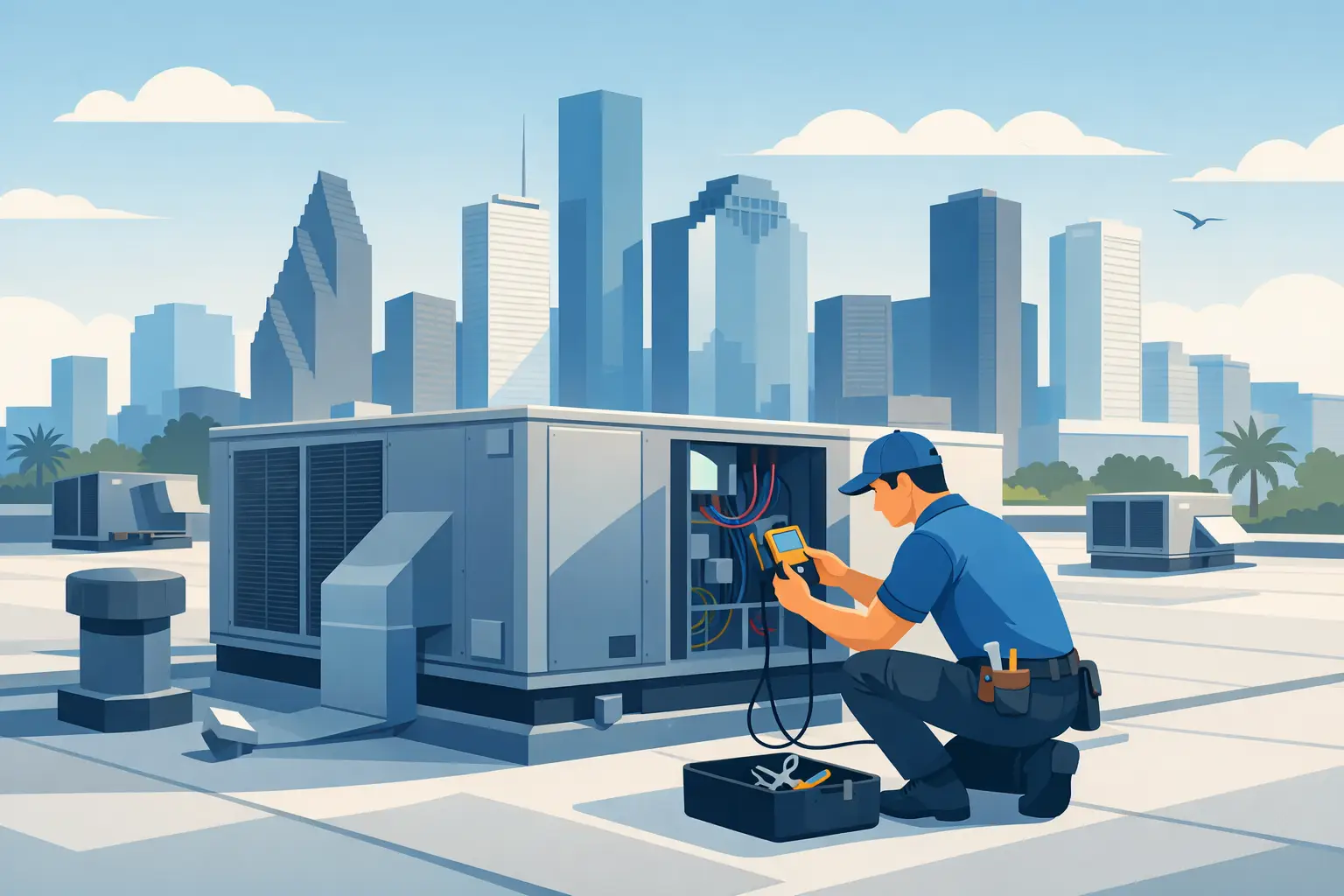
A service team arrives and starts with the basics instead of jumping to conclusions. Return air temperature is measured against supply air temperature. Airflow is checked at multiple registers. The rooftop unit is inspected for compressor operation, condenser fan performance, contactor condition, refrigerant pressures, and signs of electrical stress. In this case, the issue turns out to be a failed condenser fan motor that caused the system to overheat and stop cooling effectively.
That diagnosis matters because office cooling failures are not all equal. A thermostat issue, clogged drain line, failed capacitor, low refrigerant charge, dirty evaporator coil, failing blower motor, or aging compressor can all produce the same complaint from occupants: it is hot in here. Good recovery starts with identifying the actual cause, not just treating the symptom.
What effective recovery looks like
The first priority is occupant comfort and business continuity. In an active office, that may mean temporarily closing unused areas, relocating staff to cooler zones, and reducing heat load from lights or nonessential equipment while repairs are underway. If a business has server closets, telecom rooms, or heat-sensitive devices, those areas need immediate attention because the cost of overheating can go far beyond discomfort.
Next comes system stabilization. In the example above, once the fan motor failure was confirmed, the unit was shut down to prevent further strain on the compressor. That step can feel counterintuitive to a business owner who wants any cooling possible, but partial operation under the wrong conditions often leads to bigger damage. Sometimes the fastest recovery is to stop the equipment, protect the major components, and complete the proper repair cleanly.
With the failed part replaced, the system still is not considered recovered until testing is complete. Technicians should verify amperage draw, temperature split, refrigerant behavior, condenser operation, airflow, and thermostat response. They should also check whether the original failure caused secondary problems. A bad fan motor, for example, may have stressed capacitors or exposed dirty coils that made the system run hotter than it should have in the first place.
Why office AC failures happen when you need cooling most
Houston offices rarely lose cooling on mild days. Breakdowns tend to show up during long, high-demand stretches when systems are already working hard. That is why many emergency calls are tied to deferred maintenance, aging electrical parts, airflow restrictions, or equipment that was sized poorly for the space.
Dirty filters are one of the most common and most overlooked contributors. When airflow drops, the evaporator coil can get too cold, performance falls off, and strain rises throughout the system. Dirty condenser coils create the opposite problem outside - heat cannot leave the system efficiently, so operating pressures climb. In both cases, the office may still get some cooling for a while, which makes the issue easy to ignore until the system finally gives out.
Electrical wear is another frequent culprit. Capacitors, contactors, relays, and motors often fail under peak load. These are not dramatic parts until they stop doing their job, and then an entire office can lose cooling in minutes. For older commercial systems, a reactive strategy usually gets more expensive each summer.
Recovery is faster when the diagnosis is specific
One reason commercial cooling problems drag on is that business owners are often given broad answers instead of useful ones. If the explanation is simply that the unit is old or the system is struggling, that does not help anyone make a decision. Recovery planning needs specifics.
A strong service response explains what failed, why it failed, what was done to restore operation, and what risks remain. If the issue was a failed blower motor caused by restricted airflow, the repair and the preventive fix are different from a case involving low refrigerant from a leak. If the compressor is still operating but drawing high amperage because of repeated overheating, the conversation may shift from repair toward replacement planning.
That kind of clarity helps office managers weigh trade-offs. A repair may be the right short-term answer, especially if the system is otherwise in decent condition. But if the unit is near the end of its service life and failures are becoming more frequent, replacement may offer a better cost outcome than repeated emergency calls and lost work time.
The hidden cost of waiting too long
When an office is only slightly warm, it is tempting to wait a few days and see if the problem resolves itself. In commercial HVAC, that rarely works out well. Minor cooling loss often means the system is compensating harder to meet demand. Energy use rises, wear increases, and the eventual failure tends to happen at the worst possible time.
There is also a people cost. Employees get distracted. Customers notice comfort problems. Electronics and office equipment carry extra heat stress. For medical, retail, professional, or mixed-use office settings, indoor comfort directly affects how the business is perceived. Fast recovery is not just about temperature - it is about keeping the operation professional and functional.
That is why 24/7 emergency support has real value in this market. In Houston heat, waiting until normal business hours can turn a manageable issue into a day-long shutdown. Responsive service shortens that window and gives businesses a better chance of avoiding secondary damage.
How to reduce the odds of a repeat failure
The best office cooling failure recovery example does not end when the air starts blowing cold again. It ends when the property has a practical plan to reduce recurrence.
For most offices, that starts with scheduled maintenance before peak summer demand. Filters need consistent replacement based on actual building use, not guesswork. Coils should be cleaned. Drain lines should be cleared. Motors, capacitors, and contactors should be inspected for wear. Thermostat calibration, refrigerant performance, and airflow should be checked as part of a complete system review.
It also helps to look beyond the equipment itself. Some cooling problems are building-related. Leaky ductwork, poor insulation, solar load from west-facing windows, and interior layout changes can all shift the cooling burden. If an office was reconfigured with more people, more devices, or enclosed rooms, the original HVAC setup may no longer match the actual load.
In those cases, repair alone may restore cooling, but it may not restore reliability. System optimization, duct sealing, zoning adjustments, or a replacement plan may be the smarter move. A contractor that can handle repair, maintenance, and replacement under one roof usually gives owners a clearer path forward because the recommendation is based on the full system, not just one service call.
When repair makes sense and when replacement does
Not every office cooling failure points to a new system. If the unit is relatively young, the failure is isolated, and the overall performance history is solid, a targeted repair is often the practical choice. That keeps costs controlled and gets the office comfortable again quickly.
Replacement enters the conversation when the repair is major, the equipment is aging, efficiency is poor, or repeat failures are affecting business operations. For some owners, financing options make that decision easier because they can solve the reliability problem without taking the full cost hit all at once. That matters when the goal is not just surviving this summer but avoiding the same emergency next month.
For Houston-area businesses, local response time and local experience count. A contractor familiar with the region understands what prolonged heat, humidity, and peak-load conditions do to commercial systems. That is one reason companies like Elisee HVAC and Home Services Houston focus so heavily on both emergency repair and preventive care.
If your office cooling drops out, the right move is not to hope it recovers on its own. Treat it like an operational issue, get the system evaluated quickly, and make the fix that protects both comfort and continuity.