
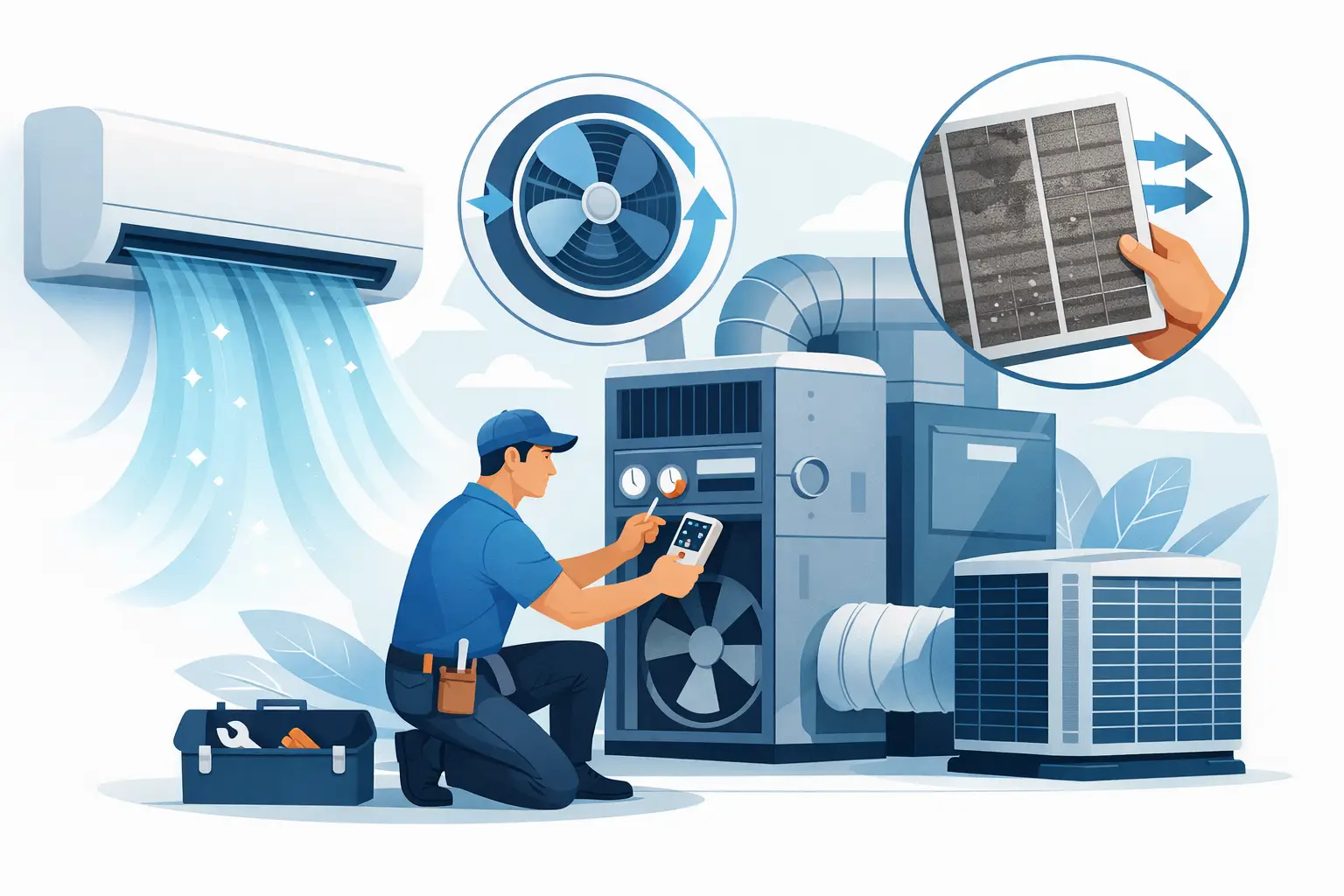
When one room in your house feels muggy, another stays warm, and the AC seems to run nonstop, airflow is usually the first place to look. In Houston, weak airflow is not a small comfort issue. It can push utility bills up, strain your equipment, and leave your home or business struggling to stay cool when you need it most.
If you are wondering how to improve HVAC airflow, the answer is rarely just one fix. Airflow problems usually come from a chain of smaller issues - a clogged filter, blocked vents, leaking ducts, a struggling blower motor, or even a system that is not sized correctly for the building. The good news is that some causes are simple to address, and others can be diagnosed quickly before they turn into bigger repair costs.
How to improve HVAC airflow without guessing
The fastest way to improve airflow is to start with the parts of the system you can see and access. In many homes and small commercial spaces, the restriction is happening at the filter, the supply vents, or the return path.
Start with the air filter. A dirty filter is one of the most common reasons airflow drops off. As the filter loads up with dust, pet hair, and debris, your system has to work harder to pull air through it. That can reduce comfort across the building and put extra strain on the blower. If the filter looks gray and packed, replace it. If you are using a very high-MERV filter, it may be catching particles well but also restricting airflow more than your system is designed to handle. Cleaner air matters, but so does matching the filter to the equipment.
Next, check your supply registers and return vents. Furniture, rugs, curtains, and storage boxes often end up blocking airflow without anyone noticing. Even partially closed registers can throw off air balance from room to room. Open the vents fully and make sure air can move freely in and out. Interior doors can also affect circulation, especially in homes where return air is limited. If a room is closed off often, pressure can build and reduce effective airflow.
Then look at the condition of the vent covers and visible duct connections. Dust buildup, loose grilles, and disconnected flexible duct sections can all reduce how much conditioned air actually reaches the room. If airflow used to be better and slowly got worse, that gradual decline often points to maintenance issues rather than a sudden equipment failure.
Why HVAC airflow gets worse over time
Airflow problems usually build slowly. That is why many property owners do not notice the cause until the system is already under stress.
Dirty evaporator coils and blower components
Even if the filter is changed regularly, your indoor coil and blower wheel can still collect dirt over time. When that happens, the blower may not move air efficiently, and the coil may struggle to transfer heat. In cooling mode, a dirty evaporator coil can also get too cold and begin to freeze. Once ice forms, airflow can drop dramatically.
This is one of those situations where the symptom and the cause can blur together. Homeowners often notice weak airflow and assume the fan is failing, when the real issue is coil contamination or a frozen coil caused by restricted airflow upstream.
Leaky or undersized ductwork
Duct systems matter more than many people realize. If ducts are leaking in the attic, crawlspace, or wall cavities, a portion of the cooled or heated air never reaches the rooms it was meant to serve. In Houston, that can mean paying to cool attic space while the living room still feels warm.
Undersized ducts create a different problem. Even if the equipment is working, the air pathway is too tight to deliver the volume the system needs. That can lead to noise, uneven temperatures, and long run times. Duct sizing is not something you can judge by eye alone, which is why persistent comfort issues often call for a professional assessment rather than repeated small fixes.
Blower motor or fan issues
If the blower motor is weakening, running at the wrong speed, or cycling irregularly, airflow will suffer. Some systems use variable-speed technology that can improve comfort and humidity control, but those systems also need proper setup. A fan setting that is too low may improve noise levels but leave rooms under-conditioned. A failing capacitor, worn motor bearings, or electrical issue can also reduce blower performance.
How to improve HVAC airflow in problem rooms
If one or two rooms are uncomfortable while the rest of the building feels mostly fine, the issue may be local rather than system-wide.
Start by comparing airflow at each supply register. If one room has noticeably weaker air than nearby spaces, the branch duct serving that room may be kinked, crushed, disconnected, or leaking. This is especially common with flexible duct in attics. A room at the far end of a long duct run may also struggle if the system was never balanced correctly.
Insulation and sun exposure also matter. A room with poor insulation, large west-facing windows, or high ceilings may feel like it has weak airflow when the real issue is a higher cooling load. More airflow might help, but not always enough on its own. In those cases, comfort may improve more with duct adjustments, zoning, insulation upgrades, or system modifications.
Return air is another overlooked factor. Supply air cannot perform well if the room has no good path for air to return to the system. Closed doors, tight spaces, and limited return design can create pressure problems that reduce effective airflow. The fix could be as simple as door undercuts or as involved as adding return pathways.
When maintenance is enough and when repair is needed
There is a point where airflow problems move beyond DIY checks. If you have replaced the filter, opened vents, and cleared obvious blockages but the airflow still feels weak, the next step is a proper system inspection.
A technician should look at static pressure, blower operation, evaporator coil condition, duct leakage, refrigerant performance, and overall system design. This matters because symptoms overlap. Weak airflow, warm air, high humidity, and frozen coils can all happen together, but the root cause is not always the same.
For example, a clogged filter can cause low airflow. So can a dirty coil, a failing blower motor, collapsed ductwork, or a return duct restriction. Treating the wrong problem wastes time and can allow avoidable damage to continue.
Routine maintenance is often the best way to catch these issues before they turn urgent. A seasonal tune-up can identify rising static pressure, dirty components, worn electrical parts, and early duct problems while the fix is still manageable. That is especially valuable during heavy summer demand, when HVAC performance is not optional.
Airflow and energy efficiency go together
Poor airflow does not just make rooms uncomfortable. It also affects efficiency, humidity control, and equipment lifespan.
When airflow is restricted, the system tends to run longer to reach the thermostat setting. Longer cycles can increase wear and drive up energy use. In cooling mode, low airflow can also leave indoor humidity higher than expected, making the space feel sticky even when the temperature looks normal on the thermostat.
That is why airflow issues deserve attention early. A system does not have to be fully broken to be costing you money. If your AC is running harder, cooling unevenly, or struggling to keep up during peak heat, airflow may be the reason performance has slipped.
For homes and businesses in the Houston area, local conditions make this even more relevant. Long cooling seasons, high humidity, and attic heat can expose weak spots in the system quickly. At Elisee HVAC and Home Services Houston, airflow concerns are often tied to a larger performance picture that includes duct condition, maintenance history, equipment age, and efficiency goals.
A better airflow fix starts with the right diagnosis
If you want to know how to improve HVAC airflow for the long term, focus less on quick guesses and more on where the restriction is actually happening. Sometimes the answer is a fresh filter and open vents. Sometimes it is duct sealing, blower repair, coil cleaning, or redesigning part of the air distribution system.
The real goal is not just stronger air coming from the vent. It is balanced comfort, lower strain on the equipment, and a system that can keep up when the weather gets serious. If your airflow has dropped off, uneven temperatures are becoming normal, or your system sounds like it is working harder than it should, getting it checked now can save you from a breakdown at the worst possible time.
A good airflow fix should make your space feel easier to live or work in - not just cooler for a day, but more dependable every day after that.