
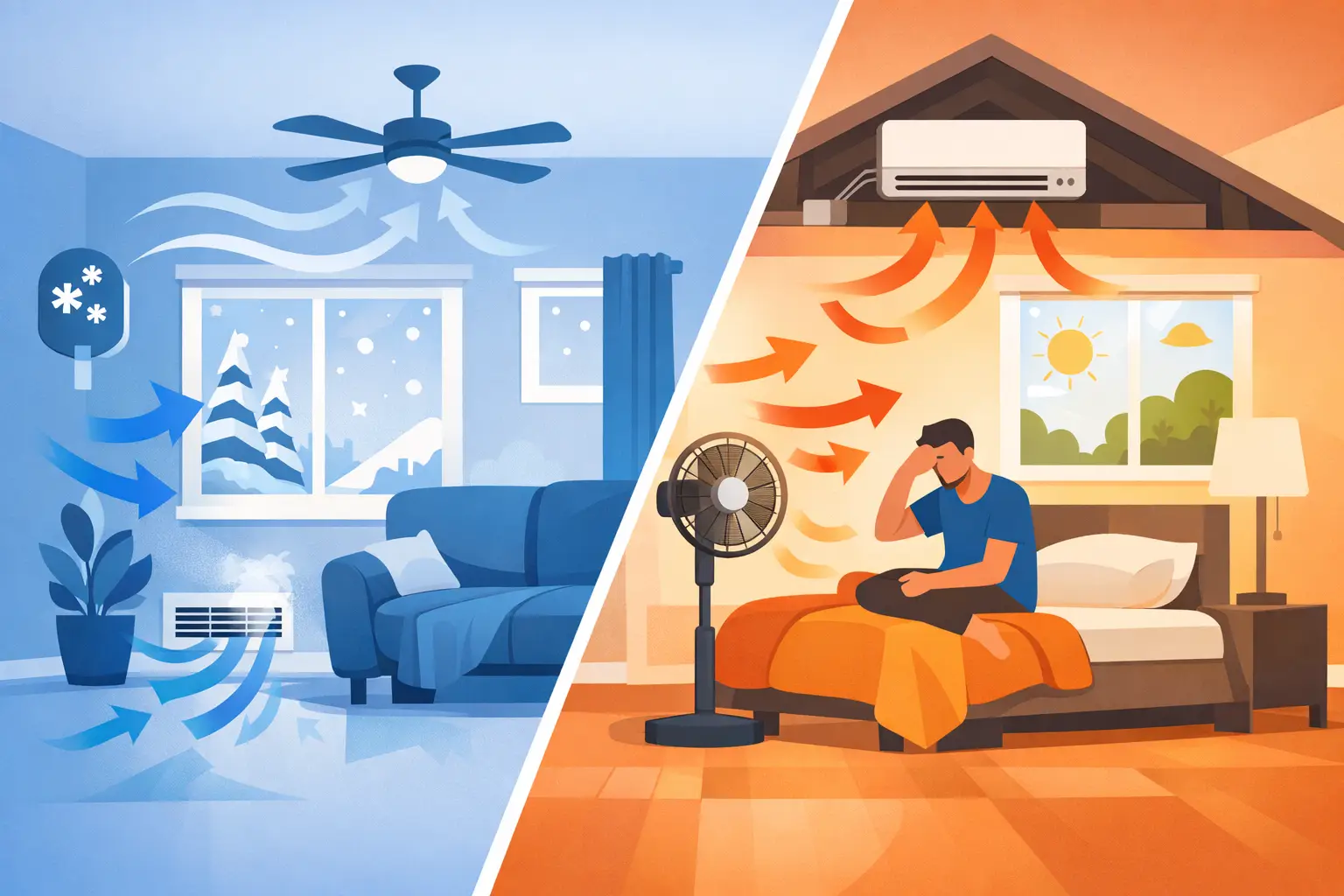
Your upstairs bedroom feels sticky at night, but the living room downstairs is freezing by midafternoon. That is one of the most common signs of an airflow problem, and in Houston, it usually shows up fast when the AC is working hard for long stretches.
An airflow imbalance does not always mean your air conditioner is failing. Often, the equipment is running, but the air is not being delivered evenly where it needs to go. For homeowners, that creates a frustrating mix of hot spots, cold spots, higher energy bills, and rooms that never seem comfortable no matter how low the thermostat is set.
This article walks through a clear airflow imbalance home example, what causes it, and how to tell whether you are dealing with a simple duct issue or a system problem that needs professional attention.
What an airflow imbalance means in a home
Airflow imbalance happens when some rooms get too much conditioned air and others do not get enough. In a properly performing system, supply air should be distributed in a way that matches the size, layout, and cooling needs of each room. Return airflow also matters because the system has to pull air back effectively to keep circulation steady.
When that balance is off, the house stops feeling consistent. One room might cool quickly while another stays warm and humid. In some homes, the imbalance shows up only during the hottest part of the day. In others, it is noticeable year-round.
That is why comfort complaints should not be brushed off as normal. Some temperature variation is expected, especially in two-story homes, but big differences usually point to an airflow issue worth checking.
A practical airflow imbalance home example
Here is a common Houston-area scenario. A two-story home has one thermostat downstairs in the hallway. During summer, the downstairs reaches the set temperature by early afternoon because it is shaded and closer to the indoor unit. The upstairs bedrooms, especially the one over the garage, stay 4 to 7 degrees warmer.
The homeowner lowers the thermostat to compensate. The result is that the downstairs becomes too cold, the system runs longer, and the upstairs still never feels quite right before bedtime. Utility bills climb, but comfort does not improve.
In this airflow imbalance home example, several things may be happening at once. The upstairs supply ducts could be too long or poorly insulated. One branch duct may have leaks in the attic. The return air path upstairs may be limited, so cool air cannot circulate back through the system properly. In some cases, the blower speed is not set correctly, or the air filter is too restrictive for the system.
This is where diagnosis matters. The symptom is one hot upstairs room, but the cause is not always inside that room.
Why airflow imbalances happen
Airflow problems usually come from the duct system, the equipment setup, or the home itself. In many houses, it is a combination.
Duct design and duct leakage
If ducts are undersized, damaged, disconnected, or leaking, air delivery drops before it ever reaches the room. This is especially common in attics, where flexible ducts can sag, kink, or separate over time. Even a small leak can reduce airflow enough to make a room feel noticeably different.
Poor duct layout also creates uneven performance. A room at the far end of the system may struggle if the duct run is too long or has too many turns. Meanwhile, a room close to the air handler may get more than its share.
Blocked or restricted airflow
Sometimes the issue is simpler. Closed supply vents, furniture blocking returns, dirty filters, or clogged evaporator coils can reduce airflow throughout the home. A room with a shut door and no good return path may also feel stuffy and warm because the air has nowhere to go.
This is one of those it-depends situations. A clogged filter can affect the whole system, while one blocked vent may cause a problem in just one room.
System sizing or setup issues
An oversized AC can cool the thermostat area too quickly and shut off before the rest of the home catches up. An undersized system may run constantly and still struggle to keep all rooms comfortable in extreme heat.
Blower settings matter too. If fan speed is not matched well to the duct system and home load, airflow can be uneven even with otherwise decent equipment.
Home layout and heat gain
Some rooms naturally take on more heat. West-facing bedrooms, rooms with large windows, spaces over garages, and converted additions often need more airflow than the rest of the house. If the original system was not adjusted for those loads, the imbalance becomes more obvious in summer.
Houston homes deal with long cooling seasons, heavy humidity, and strong attic heat. Those conditions put weak airflow design on display very quickly.
Signs your home may have an airflow imbalance
Most homeowners notice comfort first. A bedroom is always warmer, a back office is always colder, or one side of the home never seems to match the thermostat setting.
You may also notice weak air coming from certain vents, doors that push open or pull shut when the system runs, extra humidity in one area, or dust buildup that seems worse in specific rooms. Higher electric bills can show up too, especially when the thermostat keeps being adjusted to chase comfort.
Noise can be a clue. Whistling vents, rattling ductwork, or loud return air sounds often point to restrictions or pressure issues in the system.
What you can check before calling for service
A few basic checks can help you rule out easy fixes. Make sure supply vents are open and not blocked by rugs, curtains, or furniture. Check the air filter and replace it if it is dirty. Walk the house while the system is running and compare airflow from room to room.
If one room has poor airflow, see whether the door is often kept closed. In some homes, a closed room with limited return air develops pressure problems that reduce circulation. Also look for obvious duct damage in accessible attic areas, but do not force or move ducts unless you know they are supported correctly.
These checks are helpful, but they have limits. If the issue keeps returning, the problem is likely deeper than a vent adjustment.
How professionals diagnose the real cause
A proper airflow diagnosis should go beyond standing under a vent and feeling for cool air. A technician needs to look at static pressure, blower performance, duct condition, supply and return balance, and how the home is laid out.
That process may include checking temperature split, inspecting duct connections, measuring airflow at registers, and identifying restrictions in the return side. If the problem is more severe upstairs or in a particular zone of the home, the technician should trace that section of ductwork and compare it with the system's actual capacity.
This is where a reliable local HVAC team makes a difference. In Houston, systems are pushed hard, and the right fix has to hold up in real summer conditions, not just on a mild day.
The right fix depends on the cause
There is no single repair for airflow imbalance. If ducts are leaking, sealing them may restore performance. If a branch run is crushed or disconnected, repair or replacement may be needed. If return air is the issue, adding or improving a return path can make a major difference.
Some homes benefit from duct modifications or damper adjustments. Others need blower setting changes, coil cleaning, or a better filter match. In older homes or additions, the existing system may simply not be designed for the current layout and load. That can mean a more involved upgrade.
The trade-off is cost versus long-term performance. A small repair may solve one room problem quickly. But if the house has multiple comfort issues, investing in duct sealing, system optimization, or equipment replacement may reduce repeat service calls and lower monthly operating costs.
Why fast action matters in Houston
Airflow imbalances are easy to live with for too long because the system still technically runs. But uneven airflow puts extra strain on equipment, drives up runtime, and can leave parts of the home humid even when the thermostat says the temperature is fine.
Over time, that can affect comfort, efficiency, and indoor air quality. In peak summer heat, rooms with poor airflow can become hard to use, especially upstairs bedrooms, home offices, and spaces used by children or older family members.
If your house feels uneven day after day, it is worth getting it checked before the issue turns into a bigger repair. For homeowners in the Houston area, Elisee HVAC and Home Services Houston can inspect the system, identify the source of the imbalance, and recommend practical next steps based on how your home actually performs.
A comfortable home should not depend on closing doors, lowering the thermostat another two degrees, or avoiding certain rooms after lunch. When airflow is balanced correctly, comfort feels steady, bills make more sense, and your system does not have to work harder than it should.