Skipping a mechanical permit might save a few hundred dollars today, but it could cost you your entire home insurance claim after the next Houston heatwave. You likely already know that maintaining a cool, pristine home is essential for your family's comfort, yet the paperwork involved often feels like an overwhelming maze. It's natural to feel concerned that a contractor might rush a job or that you'll end up facing a $260 re-inspection fee due to a simple misunderstanding of the hvac permit requirements harris county mandates in 2026.
We believe your home should be a sanctuary, not a source of legal stress. This guide provides the clarity you need to navigate the recent 30% yearly permit fee increases and jurisdictional overlaps with confidence. You'll learn exactly when a permit is triggered, how to verify your contractor's license, and what to expect during the inspection process. We've mapped out the steps to ensure your system meets the $91.06 minimum standards for the City of Houston or the specific ordinances of unincorporated Harris County. This roadmap gives you total peace of mind that your investment is safe, legal, and meticulously installed for your family's long-term comfort.
Key Takeaways
- Identify whether your home falls under the City of Houston or unincorporated Harris County using the HCAD map to ensure you follow the correct regulatory path.
- Master the hvac permit requirements harris county mandates for full system replacements and condenser relocations to keep your home safe and compliant.
- Protect your investment by verifying your contractor’s TDLR license and ensuring they handle the meticulous filing process for you.
- Avoid costly insurance claim denials and future home sale delays by securing the necessary mechanical permits before work begins.
- Discover how a dedicated service partner can streamline the inspection process, providing you with a pristine system and total peace of mind.
Understanding Harris County HVAC Permit Regulations
Securing a mechanical permit represents more than just a bureaucratic box to check on your home improvement list. In the context of Houston home services, a mechanical permit is an official authorization from local government allowing the installation, alteration, or replacement of heating and cooling systems. Gaining a foundational knowledge of Understanding Building Permits helps homeowners see these documents as essential protection rather than red tape. These permits ensure that every technical detail, from electrical wiring to refrigerant lines, meets the rigorous safety standards required by law.
The Office of the County Engineer (OCE) serves as the primary guardian of public safety in unincorporated areas. Their inspectors verify that your contractor follows the International Mechanical Code, which prevents hazardous shortcuts that could lead to system failure. In Houston, our unique geography adds another layer of complexity. Because of our status within the National Flood Insurance Program (NFIP), hvac permit requirements harris county mandates often include specific elevation rules for exterior condensers. Placing equipment below established flood levels doesn't just risk your machinery; it can actually void your flood insurance policy.
As of January 21, 2026, the distinction between residential and commercial requirements has become even sharper. Residential trade permits now require a $100 application fee, while commercial applications start at $85 with different supplemental inspection costs. While commercial codes focus on high-occupancy safety and heavy-duty ventilation, residential codes prioritize the sanctuary of your family home, focusing on quiet efficiency and fire prevention.
Why Harris County Enforces Mechanical Codes
Strict enforcement exists to protect your family from invisible threats. High-demand Houston summers put immense strain on your home's electrical system. Inspectors verify that new units don't pull more power than your panel can safely handle, which effectively prevents house fires. They also monitor proper refrigerant handling to meet 2026 environmental standards, ensuring no harmful gases leak into your living space. Meticulous code enforcement even protects your home's bones, as improper ductwork installation can occasionally weaken floor joists or attic rafters if not handled with precision.
The 2026 Regulatory Landscape for Houston Homeowners
Recent 2026 updates to Harris County building codes emphasize extreme energy efficiency. These regulations aim to reduce the overall strain on the Texas energy grid during peak heat events. By requiring higher SEER2 ratings and better duct sealing, the county helps you lower your monthly utility bills while maintaining a pristine indoor environment. Staying compliant isn't a one-time event. Regular inspections and professional ac maintenance near me ensure your system stays within these code parameters year-round, preserving your warranty and your peace of mind.
When Do You Need a Mechanical Permit in Houston?
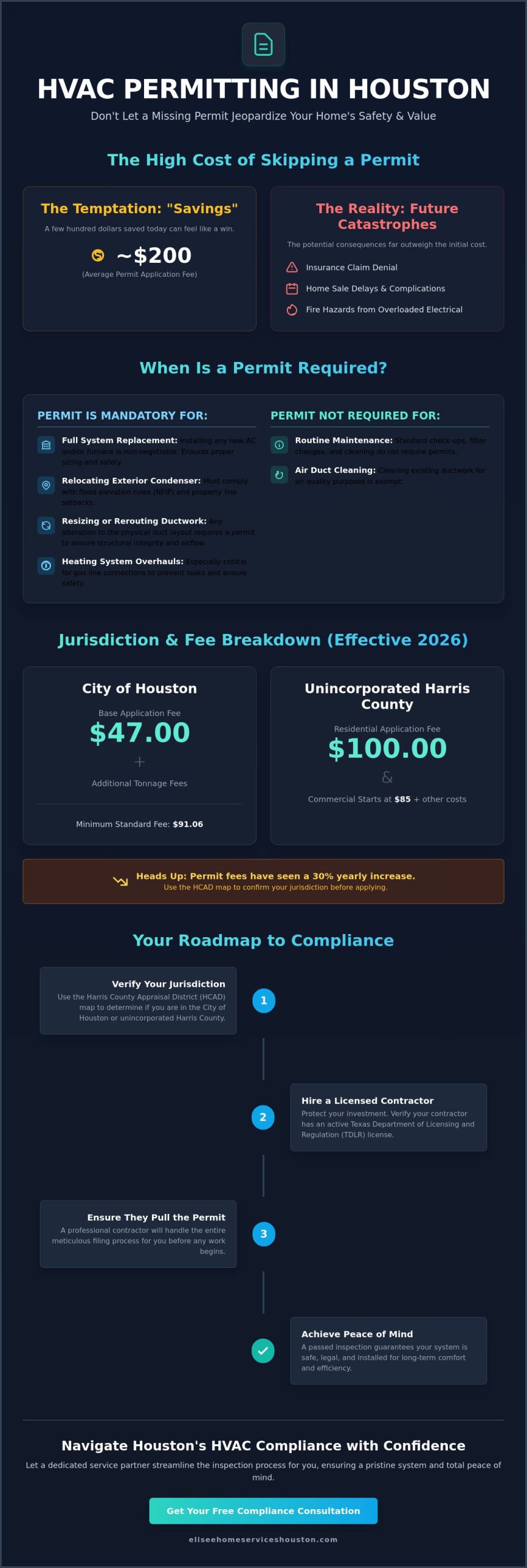
Determining whether your project requires official documentation often feels like a guessing game. For any full system replacement, the answer is a definitive yes. Whether you live within the city limits or in an unincorporated area, installing a new air conditioner is non-negotiable. The hvac permit requirements harris county enforces ensure that your new unit is sized correctly for your home's square footage, preventing the short-cycling that leads to high humidity and discomfort. If you're within the city, you can review the City of Houston HVAC Permit Process to understand their base charges of $47.00 plus tonnage fees, which apply to all complete system installs as of January 1, 2026.
Relocating your exterior condenser also triggers a permit requirement. Houston's specific flood elevations and property line setbacks mean you can't simply move a unit to the other side of the house without verification. Inspectors must confirm the equipment remains above the base flood elevation to protect your investment during heavy rains. Similarly, while routine air duct cleaning houston residents trust for air quality does not require a permit, any physical resizing or rerouting of your ductwork does. This ensures the structural integrity of your home remains intact and the airflow is balanced for maximum comfort.
Heating overhauls involve even stricter safety protocols. Because gas line connections carry inherent risks, any furnace replacement or significant modification must be inspected. This meticulous oversight prevents gas leaks and ensures proper venting of carbon monoxide, keeping your family sanctuary safe during the rare but critical Houston freezes.
Repair vs. Replacement: The Permit Threshold
Standard maintenance and minor component swaps usually fall under the exemption category. If a technician replaces a capacitor, a fan motor, or a thermostat, you typically don't need to file paperwork. However, the "Like-for-Like" rule is vital. If you replace an entire furnace or an evaporator coil, it triggers a permit because these involve permanent changes to the system's capacity or fuel source. Even during an emergency heating system repair, a dedicated professional will ensure the work follows current codes to prevent future liability.
Special Considerations for Houston Additions
Adding comfort to a garage or sunroom often involves ductless mini-splits. Harris County inspectors treat these as new circuits, requiring both mechanical and electrical verification. This is especially important when coordinating with handyman services houston homeowners use for renovations. A handyman might build the walls, but only a licensed HVAC professional should handle the permitting for the cooling system. If you're planning a home upgrade, contact us for a tailored consultation to ensure every detail of your project is compliant and precise.
Navigating the Harris County vs. City of Houston Permitting Process
Understanding which government entity governs your property is the first step toward a compliant installation. Houston's map is a complex patchwork where city limits and unincorporated areas often sit side by side. Identifying your specific jurisdiction ensures you follow the correct hvac permit requirements harris county mandates without wasting time or money on the wrong application. This clarity protects your home sanctuary and ensures your project moves forward at a confident pace.
Follow these five meticulous steps to secure your mechanical compliance:
- Step 1: Determine your jurisdiction. Use the Harris County Appraisal District (HCAD) map to look up your address. If the "Jurisdiction" field lists "City of Houston," you'll work with the Houston Permitting Center. If it shows a specific precinct or "Unincorporated," the Office of the County Engineer (OCE) handles your case.
- Step 2: Verify contractor credentials. Every HVAC professional must hold an active license from the Texas Department of Licensing and Regulation (TDLR). We recommend checking this status before any equipment arrives at your home.
- Step 3: Submit and pay. Your contractor will submit technical plans and pay the required fees. As of 2026, the minimum base permit fee for Harris County is $91 per ordinance.
- Step 4: Schedule inspections. Most projects require a final mechanical inspection. If you're doing a major renovation with open walls, a "rough-in" inspection happens first to verify internal components before they're covered.
- Step 5: Secure the Certificate of Compliance. Once the inspector signs off, you'll receive a final document. Keep this in your records. It's proof that your system is safe, legal, and insurance-compliant.
Harris County Unincorporated vs. City Limits
Residents inside the 610 loop typically fall under the Houston Permitting Center's authority. However, many homeowners in suburban pockets live in the Extraterritorial Jurisdiction (ETJ). These areas can be confusing because you might have a Houston mailing address but actually reside in unincorporated Harris County. The OCE manages these regions with a dedicated focus on public safety and flood plain management. Checking the HCAD map early prevents the headache of a rejected application or a delayed inspection.
Working with Your HVAC Contractor
A hardworking, professional contractor should always pull the permit on your behalf. This is a significant red flag if a technician asks you to apply for a "homeowner permit." That request usually means they lack the proper TDLR licensing or insurance required by the county. At Elisee Home Services, we take immense pride in our meticulous approach to paperwork. We manage every detail of the filing and inspection coordination, reclaiming your time and providing the relief that comes from a job done right the first time.
The Hidden Risks of Unpermitted HVAC Work in Texas
Skipping the paperwork might seem like a shortcut to a cooler home, but the long-term consequences can be devastating for your finances and your family's safety. Many Houstonians don't realize that homeowners insurance providers often scrutinize hvac permit requirements harris county records after a major incident. If an unpermitted air conditioner causes an electrical fire or a refrigerant leak leads to property damage, your carrier has the legal grounds to deny your claim entirely. They view uncertified work as a high-risk liability, leaving you to cover the full cost of repairs out of your own pocket.
Resale complications also haunt homeowners who ignore the permitting process. During a Houston home sale, savvy buyers and meticulous inspectors look for "zombie" permits or missing documentation. If your records don't match the equipment in your attic, it can stall your closing or force you to lower your asking price. Furthermore, major manufacturers like Carrier or Trane frequently require proof of a permitted, professional installation to honor their 10-year parts warranties. Without that city or county sign-off, you're essentially forfeiting the protection those brands provide. Beyond the money, the safety hazards of uninspected work are real. Improper venting in a gas furnace can lead to carbon monoxide buildup, turning your family sanctuary into a dangerous environment.
The Financial Fallout of Skipping Permits
Harris County officials take code compliance seriously. If an inspector discovers work started without a permit, they can assess double-fee penalties as a fine. You also face the daunting possibility of having to tear out finished work. If a technician installed a unit that doesn't meet the 2026 flood elevation standards or energy codes, the county will require a full redo before granting approval. These unexpected costs, combined with the $260 re-inspection fee for unincorporated areas, far outweigh the initial price of doing things correctly. These issues can even negatively impact your property appraisal, as unpermitted square footage or major systems aren't always recognized in your home's total value.
Peace of Mind and Family Safety
Think of the inspection as a dedicated second set of eyes on your contractor's craftsmanship. Even the most hardworking professionals can benefit from a final check to ensure every wire is tight and every drain line is pristine. This process guarantees your home remains the safe, comfortable haven your family deserves. You can reclaim your time and avoid these legal headaches by choosing a partner who values integrity over speed. If you want to ensure your next upgrade is fully compliant and expertly handled, schedule a professional HVAC consultation with our team today.
How Elisee Home Services Simplifies Houston HVAC Compliance
Managing the maze of hvac permit requirements harris county mandates shouldn't be your burden to carry. We understand that your home is your sanctuary, and the last thing you need is a stack of confusing paperwork or the fear of a failed inspection. Our team takes a meticulous and dedicated approach to every project, ensuring that your cooling system is not only pristine but also fully legal. We handle the heavy lifting of compliance so you can focus on enjoying your restored comfort. By acting as your advocate and partner, we bridge the gap between complex engineering codes and the reliable service your family deserves.
Integrity is the foundation of everything we do. Unlike clinical, franchise-style competitors who might quote a low price only to surprise you with "extra" permit fees later, we provide transparent pricing from the start. Our estimates include all necessary permitting costs and inspection coordination fees. The Elisee Guarantee ensures that every installation we perform meets or exceeds the 2026 Houston mechanical codes. This commitment provides the reassurance that your home is protected, your insurance is valid, and your system is built to last through the most demanding Texas summers.
Our Process: From Permit to Pristine Comfort
We've spent years building professional relationships with local inspectors to help expedite your project. Once we've tailored a solution for your home's unique layout, we handle all direct communication with the Office of the County Engineer. This proactive approach minimizes delays and ensures a seamless transition from installation to final sign-off. Even when you need emergency ac service holidays houston families rely on, we maintain our high legal standards. We never cut corners on safety or compliance, even in the middle of a July heatwave or a holiday weekend.
Join the Elisee Family of Protected Homeowners
Our Houston neighbors choose us because they value the peace of mind that comes from a job done right the first time. We treat your property with the same care and precision we'd use in our own homes, ensuring every connection is meticulous and every duct is sealed to 2026 efficiency standards. You aren't just another service ticket to us; you're a member of a community we've served with pride for years. We believe that a well-maintained home is the key to reclaiming your time and enjoying your family to the fullest.
Don't let the complexities of Harris County regulations stall your comfort. Let our hardworking professionals provide the authoritative guidance and personal touch you need for a worry-free upgrade. Contact us today to book your consultation and take the first step toward a code-compliant, perfectly cooled home sanctuary.
Secure Your Home Sanctuary with Professional Compliance
Ensuring your cooling system meets the hvac permit requirements harris county mandates in 2026 is about more than just following the law. It's about protecting your family's safety and your home's long-term value. We've explored how identifying your jurisdiction through the HCAD map prevents costly delays and how proper permitting safeguards your insurance claims. You now have the roadmap to navigate these technical standards with total confidence.
Our team of licensed and insured Harris County professionals takes immense pride in delivering meticulous workmanship that has earned us an A+ rating. We are local experts who understand the specific rules of every precinct, from the inner loop to the suburban ETJ. We handle every detail, from the $100 residential application fee to the final sign-off, so you can reclaim your time and enjoy a pristine living space. We believe every Houston family deserves the peace of mind that comes from a job done right.
Schedule Your Code-Compliant Houston HVAC Consultation Today and let us transform your technical needs into a worry-free home sanctuary. Your comfort is our craft, and we're ready to partner with you for a safer, cooler future.
Frequently Asked Questions
Do I need a permit for a simple AC repair in Harris County?
No, simple repairs such as replacing a capacitor, fan motor, or thermostat don't require a permit. These are considered routine maintenance items that don't change the system's capacity or fuel source. However, you must follow hvac permit requirements harris county mandates for any major component swap, such as replacing an evaporator coil or a furnace, as these impact the overall safety and efficiency of the home.
How much does an HVAC permit cost in Harris County for 2026?
As of January 1, 2026, the minimum permit fee for the City of Houston is $91.06. For a complete system installation, the city charges a base fee of $47.00 plus $11.41 per ton of refrigeration. In unincorporated Harris County, the minimum base fee starts at $91. This reflects the 30% yearly phased increases implemented to improve county review times and service quality through 2027.
Can a homeowner pull their own mechanical permit in Houston?
No, homeowners cannot pull their own mechanical permits for HVAC work in Houston or unincorporated Harris County. The law requires a contractor licensed by the Texas Department of Licensing and Regulation (TDLR) to pull the permit. This rule exists to ensure that only qualified, insured professionals handle complex electrical and refrigerant systems, protecting your family sanctuary from substandard workmanship.
How long does the Harris County HVAC inspection process take?
Most inspections are completed within 2 to 5 business days after your contractor requests the visit. Harris County is currently using the revenue from recent fee increases to hire more inspectors and reduce these wait times. Your contractor will coordinate the "rough-in" or final inspection, and you don't typically need to be present if the equipment is accessible from the exterior or attic.
What happens if I bought a Houston home with unpermitted HVAC work?
You may face significant hurdles during a future sale or insurance claim. If the county discovers unpermitted work, they can assess a $260 re-inspection fee or double-fee penalties to legalize the installation. We recommend having a meticulous professional audit the system to ensure it meets 2026 safety standards. This proactive step provides the relief of knowing your home is fully compliant and safe.
Does a new water heater installation require a permit in Harris County?
Yes, but it requires a plumbing permit rather than a mechanical permit. Even though water heaters involve heating, they fall under different regulatory codes. Both the City of Houston and Harris County enforce this to verify proper gas line connections and venting. Ensuring this permit is pulled is a vital part of maintaining a pristine and safe environment for your family.
Will my HOA require proof of a county permit for AC replacement?
Many Houston area HOAs, especially in master-planned communities, require a copy of your approved permit before they authorize exterior work. This is particularly common if you are relocating a condenser or installing a new unit that is visible from the street. Checking your specific hvac permit requirements harris county documents early helps prevent fines from your neighborhood association and ensures a smooth project flow.
How do I check if a permit was ever pulled for my current HVAC system?
You can verify your permit history by visiting the Harris County ePermits portal or the City of Houston's online permitting center. By entering your property address, you can view all active and archived permits associated with your home. If you find no record of a permit for a recent system replacement, it's best to contact a dedicated HVAC partner to discuss how to bring the system into compliance.